The programmable infrastructure conversation is shifting from experimentation to production implementation.
Financial institutions, global brands, infrastructure providers, and technology teams are looking at blockchain systems not as pilots, but as production environments that can support new markets, revenue streams, and customer experiences. As the global economy moves through a financial transformation, programmable workflows are becoming a practical way to create more efficient, connected, and adaptable systems.
That transformation requires the right partner, one that can help enterprises identify where the growth opportunities are and how to build toward them.
Enterprises need infrastructure that can scale. They need environments that can be public, private, or purpose-built. They need interoperability when connection matters, and control when business requirements demand it. They need security at the protocol level. And increasingly, they need user experiences that make onchain products feel intuitive to the people using them.
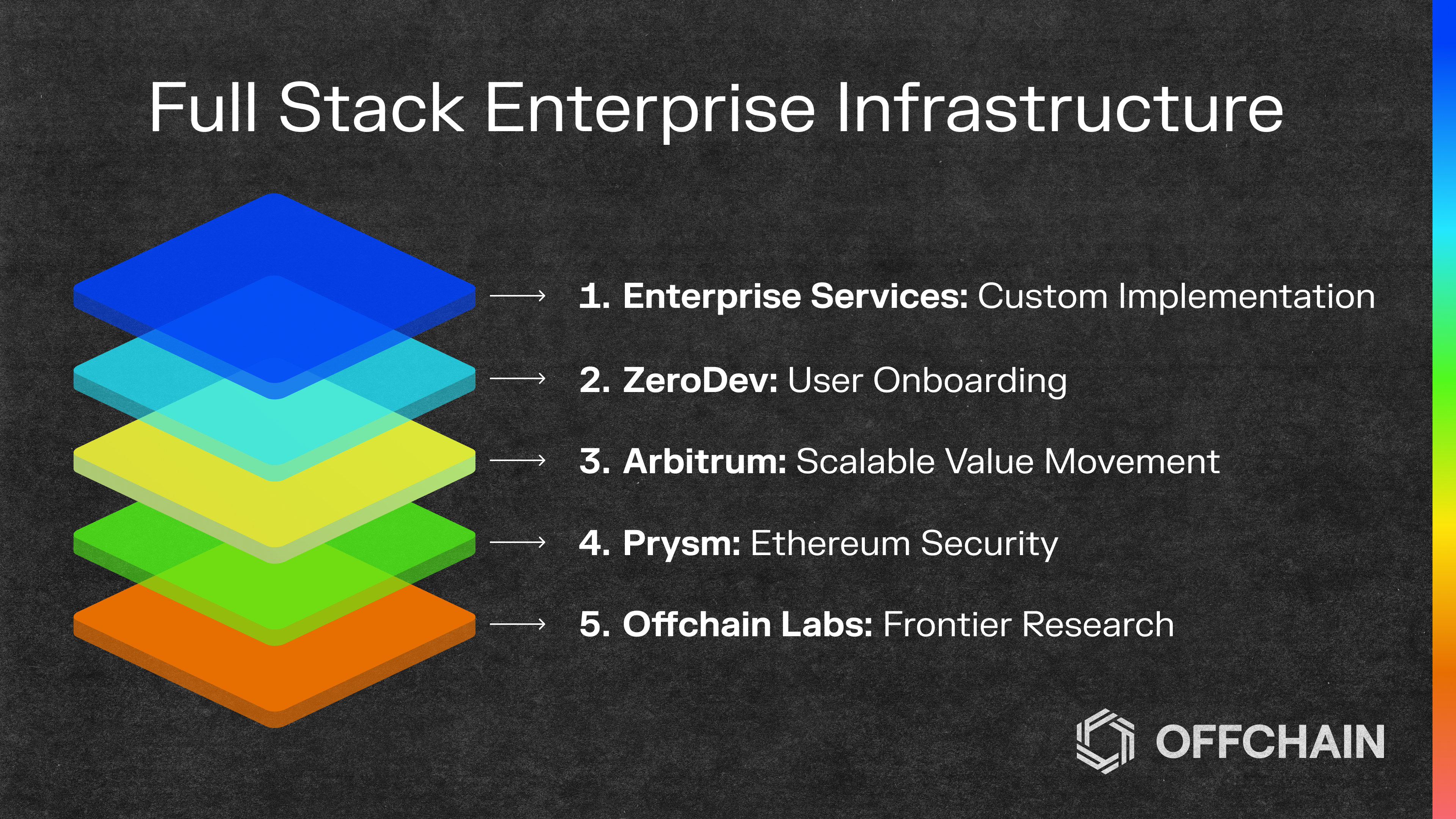
Offchain is built for that full-stack reality;
- Arbitrum gives enterprises a flexible foundation for building onchain. Teams can deploy in public environments, design private or permissioned systems, and pursue interoperable architectures as their needs evolve.
- ZeroDev brings the end user closer to the infrastructure. It helps enterprises improve onboarding, account experiences, wallet flows, and custody-aware user journeys, supporting migrations that feel like an upgrade, not a restriction.
- Prysm adds deep protocol experience and security expertise, giving enterprise teams confidence in the systems beneath their applications.
- Offchain Labs, our inhouse research arm, keeps that work connected to the frontier of blockchain infrastructure, from scalability and interoperability to privacy and protocol design.
Together, these capabilities create a practical path for enterprises moving onchain to build the infrastructure, shape the user onboarding experience, secure the system, and keep evolving with the technology.
The next phase of enterprise adoption will not be defined by pilots, it will be defined by products that make it to production, reach users, and create value.
Enterprises ready to move from onchain strategy to production?
Book a discovery with our team today
FAQs
What is enterprise blockchain infrastructure?
Enterprise blockchain infrastructure is the technical foundation that lets organizations build, deploy, secure, and scale blockchain-based applications in production. It can include public chains, private or permissioned networks, interoperability layers, account infrastructure, wallet experiences, custody integrations, protocol security, and ongoing research and development.
Why are enterprises moving from blockchain pilots to production systems?
Enterprises are moving beyond pilots because blockchain infrastructure is becoming more practical for real business use cases, including tokenized assets, programmable payments, settlement workflows, loyalty systems, identity, and new digital customer experiences. As institutional adoption grows, teams need systems that can support reliability, compliance requirements, security, and user adoption at production scale.
What should enterprises look for in a blockchain infrastructure partner?
Enterprises should look for a partner that can support the full implementation path: infrastructure design, public or private deployment options, interoperability, protocol security, user onboarding, wallet and account experience, custody-aware flows, and long-term technical evolution. The right partner should help connect strategy to production systems that users can actually adopt.
What is the difference between public, private, and permissioned blockchain infrastructure?
Public blockchain infrastructure is open and broadly accessible. Private blockchain infrastructure is controlled by a specific organization or group. Permissioned infrastructure allows selected participants to access or operate within the network under defined rules. Enterprises may use one model or a hybrid architecture depending on their privacy, compliance, performance, and interoperability needs.
Why does user experience matter in enterprise blockchain adoption?
User experience matters because blockchain products only create value if people can use them easily. Enterprises need onboarding, wallet, account, and custody flows that feel familiar and secure. A strong user experience can reduce friction, improve adoption, and make onchain products feel like an upgrade rather than a technical hurdle.